
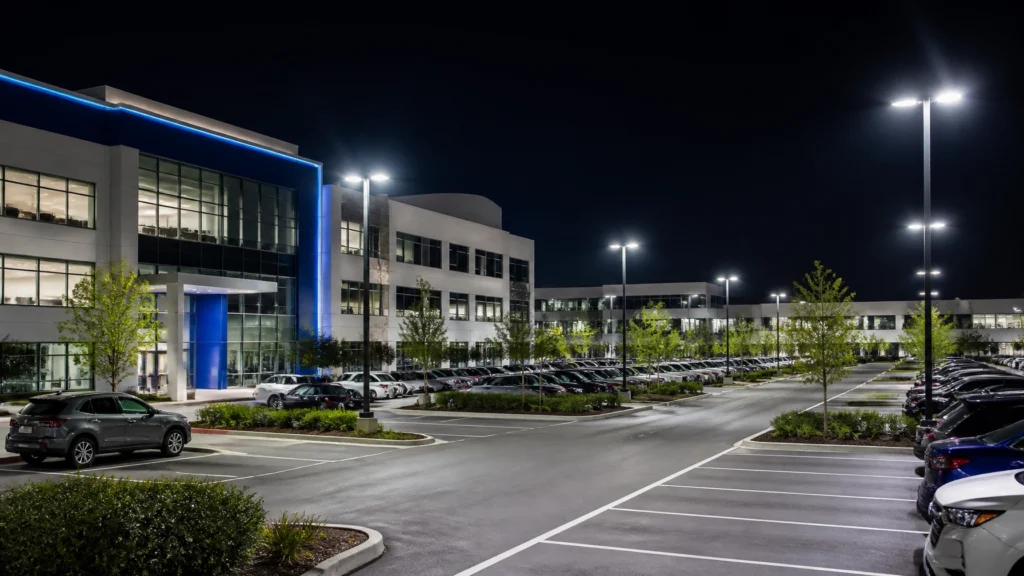
If you manage a commercial property, you know that the parking lot is the first thing a tenant, customer, or employee sees. It’s also the first thing that can go wrong. Between flickering old metal halide bulbs and those “orange-tinted” high-pressure sodium lamps that make a security camera feed look like a grainy 1970s movie, outdoor lighting is often a property manager’s biggest headache.
At Victory Lights, we’ve helped businesses from Nashville to Raleigh (and everywhere in between) swap out their dated fixtures for high-performance LED solutions. We’ve seen firsthand how a properly lit lot can slash energy bills by 50% or more while making the entire facility feel ten times safer.
But before you start ordering new poles, there are a few things you need to know. Here are the top 10 factors that will make or break your parking lot lighting project.
1. Uniformity Is More Important Than Brightness
Many people think that more light equals more safety. In reality, it’s all about uniformity. High-intensity “hot spots” followed by deep, dark shadows are a recipe for accidents and a playground for criminal activity. Your eyes have trouble adjusting to extreme changes in light levels, which creates “blind spots.”
LEDs excel here because of their precise optics. Instead of a bulb just blasting light in every direction, LED fixtures use specialized lenses to distribute light evenly across the pavement. This ensures there’s nowhere to hide and every parking bay is clearly visible.
2. The 75% Energy Savings Factor
Let’s talk numbers, because that’s what gets the CFO’s attention. Traditional High-Intensity Discharge (HID) lamps, like metal halides, are notorious energy hogs. Not only do they draw a massive amount of wattage, but they also lose efficacy over time.
By switching to LED, most of our clients see an immediate reduction in energy consumption of at least 50%. When you factor in smart controls (which we’ll get to in a second), that number can jump to 75%. That’s money that stays in your operating budget instead of going to the utility company. (And let’s be honest, who doesn’t like a lower bill?)

3. Maintenance Becomes a Thing of the Past
If you’re still using traditional lighting, you’re probably used to the “bucket truck shuffle.” Someone has to come out, go up 25 feet, and swap a bulb or a ballast every couple of years. It’s expensive, it’s annoying, and it always happens at the worst time.
A quality LED fixture is rated for 100,000 hours or more. If you run your lights 12 hours a night, that’s over 22 years of maintenance-free operation. We often tell our clients that our turnkey retrofit solutions are essentially “set it and forget it.”
4. Understanding Foot-Candle Standards
You can’t just wing it when it comes to light levels. The Illuminating Engineering Society (IES) provides specific standards for parking lot illumination. For most commercial lots, you’re looking for a minimum of 0.2 to 0.5 foot-candles of horizontal light.
If you’re running a high-security facility or a 24-hour retail spot, you’ll want to aim higher. We use professional photometric lighting audits to map out exactly where every lumen goes before we ever install a single fixture. It takes the guesswork out of the process.
5. Color Temperature and Security Cameras
Ever noticed how old streetlights make everything look yellow? That’s because they have a low Color Rendering Index (CRI). For security purposes, you want a CRI of 70 or higher.
When your lights have a neutral or cool color temperature (typically 4000K to 5000K), it’s much easier for security cameras: and human eyes: to distinguish the color of a car or a person’s clothing. This can be the difference between a useless video clip and actionable evidence.

6. Light Distribution Patterns (Type III vs. Type V)
Not all “heads” are created equal. In the lighting world, we talk about “Distribution Patterns.”
- Type III: Best for the perimeter of a lot. it pushes light forward and out to the sides, keeping light on the pavement and off the neighboring property.
- Type V: Best for the middle of a lot. It throws light in a perfect circle (or square) around the pole.
Using the wrong distribution pattern leads to “light trespass” (shining light into your neighbor’s windows) or wasted energy. Getting this right is a huge part of a professional design.
7. Smart Controls: Dimming and Sensors
Why run your lights at 100% brightness at 3:00 AM when the lot is empty? With modern LED systems, you can integrate motion sensors or scheduling.
The lights can dim to 20% when no one is around and instantly snap back to 100% the moment a car pulls in. This not only saves more money but also acts as a visual deterrent: anyone lurking in the lot will realize they’ve been “spotted” the moment the lights brighten up.
8. Dark Sky Compliance
Light pollution is a growing concern for many municipalities. Many local codes now require “Full Cutoff” fixtures. These are designed to ensure that no light is emitted upward into the sky.
Working with DarkSky International standards isn’t just about being a good neighbor; in many cities like Raleigh or Nashville, it’s actually the law. We make sure your fixtures are compliant so you don’t end up with a hefty fine from the city.
9. Utility Rebates: The Secret Weapon
This is the part everyone loves. Because LEDs are so much more efficient, many utility companies will actually pay you to make the switch.
Navigating the world of utility incentives can be a nightmare of paperwork and technical specs. That’s why we handle it for you. We’re factory-authorized dealers for brands like Philips and Sylvania, which are often pre-approved for the highest rebate tiers from organizations like the DesignLights Consortium (DLC).

10. The Value of a Turnkey Partner
You could buy a pallet of cheap LED “corn cobs” online and have your handyman screw them in, but we wouldn’t recommend it. Proper parking lot lighting requires a holistic approach: from the height of the poles to the structural integrity of the mounts.
A turnkey partner like Victory Lights handles the audit, the design, the rebate filing, and the installation. It ensures that your investment actually pays for itself in a couple of years, rather than becoming a maintenance disaster six months down the line.
Ready to brighten things up?
If your parking lot is looking a little dim: or your energy bill is looking a little high: it might be time for an upgrade. We work with everything from small retail shops to massive industrial warehouses.
Get a free quote today and let’s see how much we can save you. Your tenants (and your bottom line) will thank you!