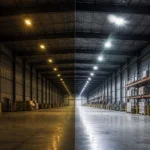
Walk into any large-scale facility: whether it’s a distribution center in Nashville or a manufacturing plant in Raleigh: and you’ll immediately feel the difference between a well-lit space and a "surviving" one.
As a property manager or chief building engineer, you know that lighting is one of your biggest overhead costs. But here’s the kicker: many facilities are paying a premium for light that actually hinders productivity. If your team is squinting at packing slips or your forklifts are slowing down in "the dark zone" near the back racks, you're losing money in more ways than just the utility bill.
At Victory Lights Inc., we’ve seen it all. We help businesses slash energy costs by up to 50%, but the biggest wins often come from fixing fundamental design errors.
Here are the 7 most common warehouse lighting mistakes we see, and exactly how you can fix them to create a safer, more profitable environment.
1. Skipping the Professional Lighting Audit
Many warehouse operators treat lighting like a grocery list: "I need 50 lights for 50,000 square feet." They buy the fixtures, hang them where the old ones were, and call it a day. The result? You end up with "hot spots" of blinding light and "dead zones" where safety hazards hide in the shadows.
The Fix: Request a Photometric Layout
Before you spend a dime on hardware, you need a data-driven plan. A professional lighting audit uses 3D modeling to calculate exactly how light will behave in your specific space. It accounts for your ceiling height, rack reflectivity, and floor material. At Victory Lights, we use these layouts to ensure that every square inch of your floor meets IES (Illuminating Engineering Society) standards before the first fixture is ever unboxed.
2. Settling for "Uneven" Illumination
Have you ever noticed your workers moving slower in certain aisles? It’s often not a morale issue: it’s a visibility issue. Poor uniformity (the ratio of the brightest spot to the darkest) forces the human eye to constantly adjust. This leads to eye strain, headaches, and: eventually: costly picking errors.
The Fix: Aim for a "Blanket" of Light
Don't just add more lumens; focus on distribution. By utilizing high-performance warehouse lighting solutions with wide-angle optics, you can create a seamless "carpet" of light. This eliminates the cave-like feel of many older facilities. If you’re managing a high-traffic area like a loading dock, you need consistent vertical and horizontal light levels to keep the pace up and the accident rate down.

3. Clinging to Outdated HID or Fluorescent Tech
If you’re still using Metal Halide or T12 fluorescents, you’re essentially burning money. Not only do these fixtures consume double the energy of modern LEDs, but they also have a "warm-up" period. If your power blinks, your team sits in the dark for 15 minutes while the lamps cool down and restrike. That’s 15 minutes of zero productivity.
The Fix: Upgrade to Industrial High Bay LED Lights
Making the switch to industrial high bay led lights is the single fastest way to drop your OpEx. Modern LEDs provide "instant-on" capability and maintain their brightness for 50,000 to 100,000 hours. We often tell our clients: the best maintenance plan is a fixture that doesn't require maintenance. Plus, as factory-authorized dealers for brands like Philips and Sylvania, we can often find energy rebates that cover a massive chunk of the upgrade cost.
4. Ignoring Color Quality and Glare
Light isn't just about brightness; it's about quality. Cheap LEDs often have a low Color Rendering Index (CRI), making everything look gray or washed out. Even worse is "direct glare": that blinding "starburst" effect when a forklift driver looks up. Glare isn't just annoying; it's a direct safety violation.
The Fix: Specify 4000K-5000K CCT and 80+ CRI
For warehouse environments, you want a "cool white" light (around 4000K to 5000K). This mimics daylight and keeps workers alert. Ensure your fixtures have a CRI of at least 80 so labels and color-coded wires are easy to distinguish. To fight glare, look for fixtures with frosted lenses or recessed optics that hide the "beads" of the LED from direct line-of-sight.
5. Using the Wrong Optics for Narrow Aisles
Standard high bays are designed to throw light in a big circle. That’s great for an open gym, but in a warehouse with 30-foot racks, most of that light hits the top of the shelves and never reaches the floor or the middle bins. You end up with "dark tunnels" where your team is using flashlights to find inventory.
The Fix: Use Precision Aisle Optics
Modern commercial led lighting allows for specialized beam angles. For racking areas, we install "aisle-grow" or linear optics that "paint" the vertical faces of your shelves. This ensures that a worker can read a small barcode on a bottom pallet just as easily as one at eye level.

6. Leaving the Lights On in Empty Aisles
Why are you paying to light an aisle that hasn't seen a forklift in three hours? In a 100,000-square-foot facility, occupancy can be as low as 20% in certain zones at any given time. Leaving every fixture at 100% power 24/7 is a massive, unnecessary drain on your budget.
The Fix: Integrated Sensors and Smart Controls
The "fix" here pays for itself almost immediately. By choosing LED fixtures with integrated motion and daylight sensors, the lights can automatically dim to 10% (or turn off entirely) when no one is around. As soon as a forklift enters the area, the lights snap back to full brightness. It’s a "set it and forget it" solution that can stack an additional 20-30% in energy savings on top of the LED conversion itself.

7. Neglecting a Maintenance and Compliance Schedule
LEDs are low-maintenance, but they aren't "no-maintenance." Dust buildup on lenses can reduce light output by up to 20% over a few years (a phenomenon called "lumen depreciation"). Furthermore, many managers forget about their emergency and egress lighting until an inspector shows up: or worse, until the power actually goes out.
The Fix: Implement a Simple Cleaning and Testing Routine
Include your lighting in your quarterly facility walk-throughs. Clean the lenses of your most critical high-traffic fixtures to keep them performing at peak levels. Most importantly, test your emergency battery backups monthly. If you aren't sure if your current setup meets OSHA safety standards, the future of your lighting depends on a quick professional check-up to ensure you’re compliant and safe.
Efficiency Pays for Itself
At the end of the day, lighting is a tool. When it’s used correctly, it’s a tool that boosts your bottom line, protects your employees, and makes your facility look like the world-class operation it is.
If you’re ready to stop making these mistakes and start seeing the savings, Victory Lights Inc. is here to help. From turnkey retrofits to expert rebate assistance, we handle the technical heavy lifting so you can focus on running your business.
Ready to see the difference a professional layout can make? Contact us today for a free consultation.