
How to Choose the Best Cummins Standby Generator for Your Business (2026 Comparison)

Power outages are expensive, disruptive, and usually badly timed. For many facilities, even a short outage can shut down point-of-sale systems, emergency lighting, HVAC equipment, refrigeration, security systems, elevators, servers, or production lines. That means lost revenue, frustrated customers, safety concerns, and in some cases damaged inventory or compliance issues. If you are evaluating standby generators in 2026, the goal is not just to buy a machine—it is to build a reliable backup power for business strategy that matches your building, your operations, and your risk level. At Victory Lights Inc., we help businesses evaluate power continuity the same way we approach commercial lighting: start with the real-world load, choose the right equipment, and install it correctly the first time.

1. Sizing Your Generator — It's Not One-Size-Fits-All

The right kW size depends on what you must keep running, not what sounds “about right.”

Choosing a cummins standby generator starts with proper sizing. This is one of the biggest decision points because undersizing creates operational risk, while oversizing can increase equipment and fuel costs without delivering practical value. A commercial standby generator should be selected based on actual electrical demand, starting loads, future expansion plans, and how much of the facility needs to stay online during an outage.

A good sizing review usually looks at:

  • Essential loads such as emergency lighting, refrigeration, IT rooms, access control, alarms, and critical HVAC
  • Large motor starting requirements for compressors, pumps, and air handlers
  • Whether you need whole-building backup or only life-safety and business-critical circuits
  • Expected growth over the next 3 to 5 years
  • Utility characteristics and local code requirements

This is where load calculations matter. Generator sizing is typically expressed in kilowatts (kW), but your electrician or generator specialist may also review amperage, voltage, phase, and starting kVA. For example, a small professional office may only need backup for lighting, networking, phones, and a few HVAC loads. A medical office, warehouse, or retail operation may require a much larger unit because motor loads and refrigeration can spike during startup.

If you size too small, then the generator may struggle when multiple systems start at once, resulting in nuisance shutdowns or unstable performance. If you size too large, then you may pay more upfront and operate less efficiently over time. The sweet spot is a generator that covers your critical loads with reasonable headroom. That is why we recommend starting with a professional site review through Victory Lights Inc. before comparing models.

2. Fuel Type: Natural Gas vs. Propane vs. Diesel

Each fuel has tradeoffs in runtime, storage, maintenance, and site logistics.

Fuel type has a direct impact on reliability, installation complexity, and long-term operating cost. The “best” option depends on your site conditions and how your business uses power during emergencies.

Natural Gas

Best when utility gas service is reliable and continuous fuel supply is the priority.

Natural gas is a popular option for standby generators because there is no on-site refueling tank to manage in the same way as diesel or propane. If your building already has adequate gas service, natural gas can simplify long outage planning.

Pros:

  • Continuous fuel source from the gas utility
  • No on-site diesel fuel degradation issues
  • Cleaner-burning than diesel
  • Good option for many offices, retail sites, and light commercial properties

Cons:

  • Dependent on gas utility availability and pressure
  • May require gas service upgrades
  • Slightly lower energy density than diesel

Propane

Best for sites without natural gas access that still want a clean-burning fuel.

Propane is often used where natural gas infrastructure is limited. It stores well and can be an excellent fit for rural or semi-rural commercial properties.

Pros:

  • Long shelf life
  • Cleaner-burning fuel
  • Useful where natural gas is not available
  • Flexible tank sizing options

Cons:

  • Requires on-site tank storage
  • Refueling logistics matter during extended outages
  • Tank placement must meet code and site constraints

Diesel

Best for larger industrial applications where high power density and durability matter most.

Diesel remains a leading option for heavy-duty and high-capacity commercial standby generator applications. It is common in industrial plants, healthcare environments, infrastructure sites, and other mission-critical operations.

Pros:

  • Strong performance for large loads
  • High energy density
  • Often preferred for high-capacity applications
  • Proven reliability in industrial settings

Cons:

  • Requires on-site fuel storage and maintenance
  • Fuel can degrade if not properly managed
  • Emissions and local regulations may add complexity
  • Noise levels can be higher depending on enclosure design

If your priority is convenience, natural gas often makes sense. If utility gas is unavailable, propane may be the practical answer. If you need serious output for a larger facility, diesel may be the better fit. In other words, fuel choice is not just about preference—it is about resilience, site design, and operating profile. Our team at Victory Lights Inc. can help compare these options based on your facility layout and uptime requirements.

3. ATS Technology — The Brain of Your Backup System

A generator is only part of the system; the automatic transfer switch is what makes backup power truly automatic.

An automatic transfer switch monitors incoming utility power and signals the generator to start when the utility fails. Once generator power stabilizes, the switch transfers the building load from utility to generator. When utility power returns, the ATS switches the facility back and allows the generator to shut down safely after its cooldown cycle.

That is why we call the ATS the brain of the backup system. Without a properly selected automatic transfer switch, even a high-quality generator cannot deliver the seamless response most businesses need.

Key ATS considerations include:

  • Service entrance rated vs. non-service entrance rated designs
  • Open transition vs. closed transition transfer
  • Load shedding capability for non-critical circuits
  • Integration with fire alarm, elevator, HVAC, or BMS controls
  • Indoor vs. outdoor enclosure requirements
  • Proper amperage and voltage matching with the generator and facility service

For a business owner, the practical question is simple: how quickly do you need systems restored, and which systems matter most? If a 10-second interruption is acceptable for some circuits but not for others, then the distribution design should reflect that. A well-planned ATS setup protects operations, simplifies recovery, and reduces the chance of human error during an outage. That is a major reason businesses investing in backup power for business should evaluate the full system—not just the engine and alternator package.

4. QuietConnect vs. Centum — Which Series Is Right for You?

These Cummins product families serve very different business needs, so the better choice depends on your facility type and load profile.

Cummins offers multiple generator platforms, but two names that often come up in planning discussions are QuietConnect and Centum. While exact specifications vary by model and market availability, these series generally serve different use cases.

QuietConnect is designed for applications where lower sound output, compact footprints, and commercial-friendly operation matter. Centum is built for larger, more demanding industrial and mission-critical environments where capacity and robust performance take center stage.

2026 Comparison Table: QuietConnect vs. Centum

Feature QuietConnect™ Centum™ Series
Typical Power Range 13kW – 150kW 500kW – 1000kW+
Primary Fuel Natural Gas / Propane Diesel / Natural Gas
Sound Level Extremely Quiet (60-65 dB) Industrial Sound Attenuated
Best For Small Offices, Retail, Clinics Data Centers, Industrial Plants
Footprint More compact for tighter commercial sites Larger equipment footprint for high-capacity installations
Scalability Ideal for small to mid-size critical loads Better suited for large infrastructure and mission-critical redundancy
Warranty Options Up to 10-Year Extended Industrial Performance Tiers

If you operate a retail store, church, clinic, small warehouse, or office complex, QuietConnect may cover all three bases: dependable backup, manageable sound levels, and a cleaner fit for customer-facing environments. If you run a large industrial plant, data center, or infrastructure-heavy property, Centum may be the more appropriate platform because it is designed for more demanding loads and larger-scale deployment.

The point is not to chase the biggest unit. It is to match the right series to the right application. That is where an experienced dealer like Victory Lights Inc. can save you from an expensive mismatch.

5. Remote Monitoring and the 10-Year Warranty

Modern generator ownership is easier when you can see status in real time and lock in long-term coverage.

A modern cummins standby generator is more than an engine in an enclosure. Remote monitoring gives facility managers and owners visibility into generator status, maintenance alerts, exercise cycles, and alarm conditions through connected platforms and mobile tools. That means you do not have to wonder whether the unit is ready after a storm warning or overnight utility disturbance.

For businesses managing multiple properties, this matters even more. Remote visibility can help maintenance teams confirm readiness across locations without unnecessary site visits. In practical terms, faster visibility usually results in faster response.

Beyond monitoring, Cummins offers strong protection options, including extended coverage that can significantly reduce long-term ownership surprises. While standard warranties cover the basics, many businesses benefit from a 10-year extended warranty because it helps turn emergency power equipment into a more predictable capital asset.

That matters for budgeting. If you are comparing one system with limited coverage against another with stronger long-term protection, the lower upfront number may not actually be the better value. If one major repair hits in year six, then the “cheaper” option may stop looking cheap in a hurry.

To learn more about complete facility support solutions, from energy-saving lighting upgrades to backup power planning, visit Victory Lights Inc..

6. Installation Costs and the Victory Lights Advantage

Generator installation cost includes much more than the generator itself, so turnkey planning is critical.

When businesses ask about generator installation cost, the answer depends on much more than generator size. The equipment price is only one piece of the project. Site conditions, code requirements, and utility coordination often drive a significant share of the final number.

Typical installation cost factors include:

  • Local permits and engineering
  • Concrete pads and site preparation
  • Crane or equipment placement logistics
  • Gas line plumbing or diesel fuel system setup
  • Main electrical tie-ins and distribution modifications
  • Automatic transfer switch equipment and wiring
  • Sound attenuation or enclosure requirements
  • Startup, testing, and inspection
  • Local code compliance and final approvals

For example, if the generator location is close to the electrical service and gas source, then installation may be more straightforward. If the unit requires a long trench run, upgraded gas meter, larger pad, bollards, acoustic treatment, or multiple ATS connections, then costs will rise accordingly. That is normal—and it is exactly why “generator price” and “project price” are not the same thing.

At Victory Lights Inc., we provide a turnkey approach that simplifies the process. We help clients evaluate load requirements, site placement, permitting, pad construction, utility coordination, and startup planning so the system is designed as a complete package. Instead of juggling multiple vendors and hoping everyone interprets the drawings the same way, you get one coordinated path forward. For busy property managers and building owners, that saves time, reduces friction, and results in a cleaner installation.

Conclusion: Protect Your Business Before the Next Outage

A properly selected generator does more than keep the lights on. It protects revenue, safety, equipment, customer confidence, and day-to-day operational continuity. The best standby generators are the ones that are correctly sized, paired with the right fuel source, integrated with the right automatic transfer switch, and installed with a clear understanding of your building’s real-world needs.

If you are comparing a cummins standby generator for a retail site, medical office, warehouse, church, or industrial facility, Victory Lights Inc. can help you build a practical solution that pays for itself in uptime, protection, and peace of mind. Visit www.victorylightsinc.com to learn more, or call (800) 443-0870 today to discuss the right commercial standby generator for your facility. When the grid goes down, your business should not have to.
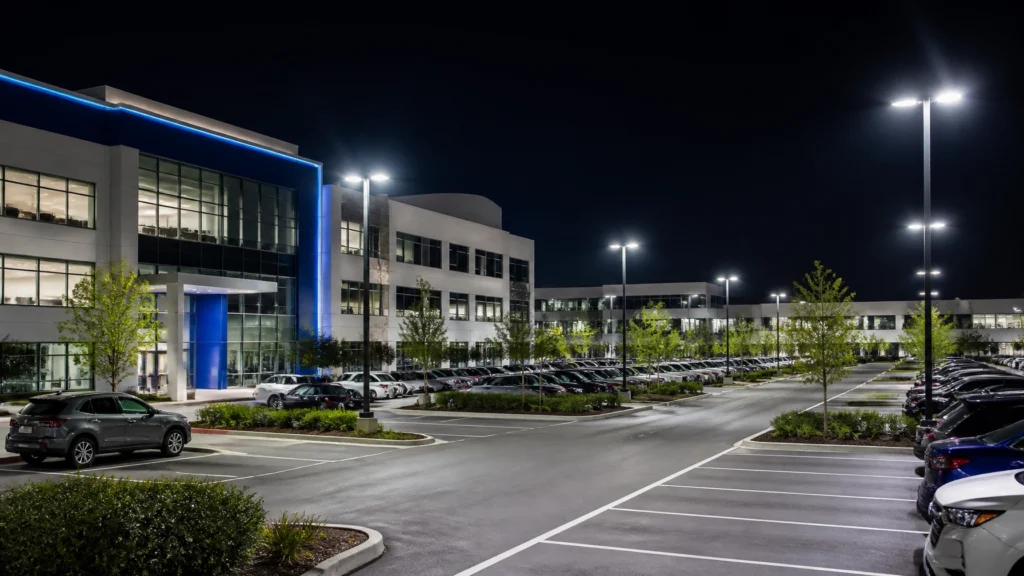
Parking Lot LED Lighting: 10 Things You Should Know

Parking Lot WordPress - Victory Lights Inc

If you manage a commercial property, you know that the parking lot is the first thing a tenant, customer, or employee sees. It’s also the first thing that can go wrong. Between flickering old metal halide bulbs and those “orange-tinted” high-pressure sodium lamps that make a security camera feed look like a grainy 1970s movie, outdoor lighting is often a property manager’s biggest headache.

At Victory Lights, we’ve helped businesses from Nashville to Raleigh (and everywhere in between) swap out their dated fixtures for high-performance LED solutions. We’ve seen firsthand how a properly lit lot can slash energy bills by 50% or more while making the entire facility feel ten times safer.

But before you start ordering new poles, there are a few things you need to know. Here are the top 10 factors that will make or break your parking lot lighting project.

1. Uniformity Is More Important Than Brightness

Many people think that more light equals more safety. In reality, it’s all about uniformity. High-intensity “hot spots” followed by deep, dark shadows are a recipe for accidents and a playground for criminal activity. Your eyes have trouble adjusting to extreme changes in light levels, which creates “blind spots.”

LEDs excel here because of their precise optics. Instead of a bulb just blasting light in every direction, LED fixtures use specialized lenses to distribute light evenly across the pavement. This ensures there’s nowhere to hide and every parking bay is clearly visible.

2. The 75% Energy Savings Factor

Let’s talk numbers, because that’s what gets the CFO’s attention. Traditional High-Intensity Discharge (HID) lamps, like metal halides, are notorious energy hogs. Not only do they draw a massive amount of wattage, but they also lose efficacy over time.

By switching to LED, most of our clients see an immediate reduction in energy consumption of at least 50%. When you factor in smart controls (which we’ll get to in a second), that number can jump to 75%. That’s money that stays in your operating budget instead of going to the utility company. (And let’s be honest, who doesn’t like a lower bill?)

A close-up of a modern, high-performance LED outdoor fixture showing advanced lens technology and industrial design.

3. Maintenance Becomes a Thing of the Past

If you’re still using traditional lighting, you’re probably used to the “bucket truck shuffle.” Someone has to come out, go up 25 feet, and swap a bulb or a ballast every couple of years. It’s expensive, it’s annoying, and it always happens at the worst time.

A quality LED fixture is rated for 100,000 hours or more. If you run your lights 12 hours a night, that’s over 22 years of maintenance-free operation. We often tell our clients that our turnkey retrofit solutions are essentially “set it and forget it.”

4. Understanding Foot-Candle Standards

You can’t just wing it when it comes to light levels. The Illuminating Engineering Society (IES) provides specific standards for parking lot illumination. For most commercial lots, you’re looking for a minimum of 0.2 to 0.5 foot-candles of horizontal light.

If you’re running a high-security facility or a 24-hour retail spot, you’ll want to aim higher. We use professional photometric lighting audits to map out exactly where every lumen goes before we ever install a single fixture. It takes the guesswork out of the process.

5. Color Temperature and Security Cameras

Ever noticed how old streetlights make everything look yellow? That’s because they have a low Color Rendering Index (CRI). For security purposes, you want a CRI of 70 or higher.

When your lights have a neutral or cool color temperature (typically 4000K to 5000K), it’s much easier for security cameras: and human eyes: to distinguish the color of a car or a person’s clothing. This can be the difference between a useless video clip and actionable evidence.

The Nashville skyline at dusk, representing one of the major commercial hubs served by Victory Lights Inc.

6. Light Distribution Patterns (Type III vs. Type V)

Not all “heads” are created equal. In the lighting world, we talk about “Distribution Patterns.”

  • Type III: Best for the perimeter of a lot. it pushes light forward and out to the sides, keeping light on the pavement and off the neighboring property.
  • Type V: Best for the middle of a lot. It throws light in a perfect circle (or square) around the pole.

Using the wrong distribution pattern leads to “light trespass” (shining light into your neighbor’s windows) or wasted energy. Getting this right is a huge part of a professional design.

7. Smart Controls: Dimming and Sensors

Why run your lights at 100% brightness at 3:00 AM when the lot is empty? With modern LED systems, you can integrate motion sensors or scheduling.

The lights can dim to 20% when no one is around and instantly snap back to 100% the moment a car pulls in. This not only saves more money but also acts as a visual deterrent: anyone lurking in the lot will realize they’ve been “spotted” the moment the lights brighten up.

8. Dark Sky Compliance

Light pollution is a growing concern for many municipalities. Many local codes now require “Full Cutoff” fixtures. These are designed to ensure that no light is emitted upward into the sky.

Working with DarkSky International standards isn’t just about being a good neighbor; in many cities like Raleigh or Nashville, it’s actually the law. We make sure your fixtures are compliant so you don’t end up with a hefty fine from the city.

9. Utility Rebates: The Secret Weapon

This is the part everyone loves. Because LEDs are so much more efficient, many utility companies will actually pay you to make the switch.

Navigating the world of utility incentives can be a nightmare of paperwork and technical specs. That’s why we handle it for you. We’re factory-authorized dealers for brands like Philips and Sylvania, which are often pre-approved for the highest rebate tiers from organizations like the DesignLights Consortium (DLC).

A bright, professionally lit interior of a medical facility, demonstrating the high-quality LED standards Victory Lights provides.

10. The Value of a Turnkey Partner

You could buy a pallet of cheap LED “corn cobs” online and have your handyman screw them in, but we wouldn’t recommend it. Proper parking lot lighting requires a holistic approach: from the height of the poles to the structural integrity of the mounts.

A turnkey partner like Victory Lights handles the audit, the design, the rebate filing, and the installation. It ensures that your investment actually pays for itself in a couple of years, rather than becoming a maintenance disaster six months down the line.

Ready to brighten things up?

If your parking lot is looking a little dim: or your energy bill is looking a little high: it might be time for an upgrade. We work with everything from small retail shops to massive industrial warehouses.

Get a free quote today and let’s see how much we can save you. Your tenants (and your bottom line) will thank you!

7 Mistakes You’re Making with Your Warehouse Lighting (and How to Fix Them)

Walk into any large-scale facility: whether it’s a distribution center in Nashville or a manufacturing plant in Raleigh: and you’ll immediately feel the difference between a well-lit space and a "surviving" one.

As a property manager or chief building engineer, you know that lighting is one of your biggest overhead costs. But here’s the kicker: many facilities are paying a premium for light that actually hinders productivity. If your team is squinting at packing slips or your forklifts are slowing down in "the dark zone" near the back racks, you're losing money in more ways than just the utility bill.

At Victory Lights Inc., we’ve seen it all. We help businesses slash energy costs by up to 50%, but the biggest wins often come from fixing fundamental design errors.

Here are the 7 most common warehouse lighting mistakes we see, and exactly how you can fix them to create a safer, more profitable environment.


1. Skipping the Professional Lighting Audit

Many warehouse operators treat lighting like a grocery list: "I need 50 lights for 50,000 square feet." They buy the fixtures, hang them where the old ones were, and call it a day. The result? You end up with "hot spots" of blinding light and "dead zones" where safety hazards hide in the shadows.

The Fix: Request a Photometric Layout
Before you spend a dime on hardware, you need a data-driven plan. A professional lighting audit uses 3D modeling to calculate exactly how light will behave in your specific space. It accounts for your ceiling height, rack reflectivity, and floor material. At Victory Lights, we use these layouts to ensure that every square inch of your floor meets IES (Illuminating Engineering Society) standards before the first fixture is ever unboxed.

2. Settling for "Uneven" Illumination

Have you ever noticed your workers moving slower in certain aisles? It’s often not a morale issue: it’s a visibility issue. Poor uniformity (the ratio of the brightest spot to the darkest) forces the human eye to constantly adjust. This leads to eye strain, headaches, and: eventually: costly picking errors.

The Fix: Aim for a "Blanket" of Light
Don't just add more lumens; focus on distribution. By utilizing high-performance warehouse lighting solutions with wide-angle optics, you can create a seamless "carpet" of light. This eliminates the cave-like feel of many older facilities. If you’re managing a high-traffic area like a loading dock, you need consistent vertical and horizontal light levels to keep the pace up and the accident rate down.

A professional view of a warehouse loading dock, demonstrating high-uniformity lighting that ensures safety and efficiency during night operations.

3. Clinging to Outdated HID or Fluorescent Tech

If you’re still using Metal Halide or T12 fluorescents, you’re essentially burning money. Not only do these fixtures consume double the energy of modern LEDs, but they also have a "warm-up" period. If your power blinks, your team sits in the dark for 15 minutes while the lamps cool down and restrike. That’s 15 minutes of zero productivity.

The Fix: Upgrade to Industrial High Bay LED Lights
Making the switch to industrial high bay led lights is the single fastest way to drop your OpEx. Modern LEDs provide "instant-on" capability and maintain their brightness for 50,000 to 100,000 hours. We often tell our clients: the best maintenance plan is a fixture that doesn't require maintenance. Plus, as factory-authorized dealers for brands like Philips and Sylvania, we can often find energy rebates that cover a massive chunk of the upgrade cost.

4. Ignoring Color Quality and Glare

Light isn't just about brightness; it's about quality. Cheap LEDs often have a low Color Rendering Index (CRI), making everything look gray or washed out. Even worse is "direct glare": that blinding "starburst" effect when a forklift driver looks up. Glare isn't just annoying; it's a direct safety violation.

The Fix: Specify 4000K-5000K CCT and 80+ CRI
For warehouse environments, you want a "cool white" light (around 4000K to 5000K). This mimics daylight and keeps workers alert. Ensure your fixtures have a CRI of at least 80 so labels and color-coded wires are easy to distinguish. To fight glare, look for fixtures with frosted lenses or recessed optics that hide the "beads" of the LED from direct line-of-sight.

5. Using the Wrong Optics for Narrow Aisles

Standard high bays are designed to throw light in a big circle. That’s great for an open gym, but in a warehouse with 30-foot racks, most of that light hits the top of the shelves and never reaches the floor or the middle bins. You end up with "dark tunnels" where your team is using flashlights to find inventory.

The Fix: Use Precision Aisle Optics
Modern commercial led lighting allows for specialized beam angles. For racking areas, we install "aisle-grow" or linear optics that "paint" the vertical faces of your shelves. This ensures that a worker can read a small barcode on a bottom pallet just as easily as one at eye level.

A narrow warehouse aisle featuring linear LED lighting designed to provide vertical illumination on rack faces, making inventory easy to manage.

6. Leaving the Lights On in Empty Aisles

Why are you paying to light an aisle that hasn't seen a forklift in three hours? In a 100,000-square-foot facility, occupancy can be as low as 20% in certain zones at any given time. Leaving every fixture at 100% power 24/7 is a massive, unnecessary drain on your budget.

The Fix: Integrated Sensors and Smart Controls
The "fix" here pays for itself almost immediately. By choosing LED fixtures with integrated motion and daylight sensors, the lights can automatically dim to 10% (or turn off entirely) when no one is around. As soon as a forklift enters the area, the lights snap back to full brightness. It’s a "set it and forget it" solution that can stack an additional 20-30% in energy savings on top of the LED conversion itself.

A close-up of a modern industrial LED high bay fixture equipped with an integrated occupancy sensor for maximum energy efficiency.

7. Neglecting a Maintenance and Compliance Schedule

LEDs are low-maintenance, but they aren't "no-maintenance." Dust buildup on lenses can reduce light output by up to 20% over a few years (a phenomenon called "lumen depreciation"). Furthermore, many managers forget about their emergency and egress lighting until an inspector shows up: or worse, until the power actually goes out.

The Fix: Implement a Simple Cleaning and Testing Routine
Include your lighting in your quarterly facility walk-throughs. Clean the lenses of your most critical high-traffic fixtures to keep them performing at peak levels. Most importantly, test your emergency battery backups monthly. If you aren't sure if your current setup meets OSHA safety standards, the future of your lighting depends on a quick professional check-up to ensure you’re compliant and safe.


Efficiency Pays for Itself

At the end of the day, lighting is a tool. When it’s used correctly, it’s a tool that boosts your bottom line, protects your employees, and makes your facility look like the world-class operation it is.

If you’re ready to stop making these mistakes and start seeing the savings, Victory Lights Inc. is here to help. From turnkey retrofits to expert rebate assistance, we handle the technical heavy lifting so you can focus on running your business.

Ready to see the difference a professional layout can make? Contact us today for a free consultation.

Are Fluorescents Dead? Why Your Business Needs an LED Retrofit Now

Contrast Lighting Photo - Victory Lights Inc

For decades, the hum and flicker of fluorescent tubes were the soundtrack to the American workplace. Whether you were managing a sprawling warehouse in Nashville or a high-end retail showroom in Raleigh, those long glass tubes were simply "the way it was done." But as we move through 2026, the verdict is in: the era of the fluorescent lamp is officially over.

If you’re still clinging to your T8 or T12 fixtures, you aren't just using old technology: you’re likely leaving thousands of dollars on the table every single year. At Victory Lights Inc., we’ve helped businesses across the continental U.S. transition to modern commercial LED lighting, and the results aren't just aesthetic. They’re transformative for the bottom line.

Here are the seven principal reasons why your business needs an LED lighting retrofit: and why you need it right now.

1. The 50% Energy Savings Rule

Let’s start with the most pragmatic factor: cost. It’s a common misconception that LEDs are only "slightly" better than modern fluorescents. In reality, switching from fluorescent to LED typically cuts your lighting energy consumption by 30% to 50% immediately. For high-run-time facilities like 24/7 distribution centers or medical complexes, those savings can even reach 75%.

Think of it this way: for every dollar you currently spend on lighting, 50 cents is essentially being thrown away as heat. LEDs are vastly more efficient at converting electrons into photons, resulting in a system that pays for itself in a remarkably short timeframe.

2. Maintenance-Free is the New Standard

If you’re a property manager or a chief building engineer, you know the drill. A tube goes out, the lift has to be rented, a technician spends two hours reaching a 30-foot ceiling, and by the time they’re done, three more bulbs in the next aisle have started to flicker. It’s a never-ending cycle of "spot maintenance" that eats up labor hours and budget.

Our industrial LED light fixtures are designed to be virtually maintenance-free. While a standard fluorescent might last 15,000 to 20,000 hours, high-quality LEDs from brands like Philips and Sylvania (for which we are factory-authorized dealers) are rated for 50,000 to 100,000 hours. That is over a decade of "set it and forget it" performance.

A high-detail commercial photograph showing a sleek industrial LED high-bay fixture next to a dusty, broken T12 fluorescent tube, highlighting the technological leap.

3. The 2026 Rebate "Cliff"

This is perhaps the most urgent reason to act. In 2026, we are seeing a massive shift in how utility companies handle incentives. Many utilities are phasing out rebates for fluorescent-to-fluorescent upgrades entirely. Even basic LED retrofits are starting to see reduced incentive levels as LEDs become the new baseline.

The "sweet spot" for rebates right now is high-efficiency LED systems paired with smart controls (occupancy sensors and daylight harvesting). By acting now, you can still secure significant energy rebates that cover a substantial portion of your project costs. Wait another year, and that "free money" may be gone.

4. Visual Clarity and Workplace Safety

Lighting isn't just about seeing; it’s about working. In an industrial setting, poor lighting is a safety hazard. Fluorescent lights tend to dim over time (a process called lumen depreciation) and have poor Color Rendering Index (CRI). This makes it harder for workers to distinguish colors, read labels, or spot hazards on a warehouse floor.

LEDs provide "instant-on" brightness with superior CRI. This creates a high-contrast environment where textures and edges are sharp. Whether it’s a retail showroom where product colors need to pop or a medical facility where precision is paramount, the quality of light directly impacts performance.

A modern retail showroom featuring professional high-efficiency linear LED fixtures and recessed spotlights that create a bright, professional atmosphere.

5. Heat Reduction and HVAC Synergy

Fluorescents are surprisingly hot. When you have hundreds of them in a facility, your HVAC system has to work overtime to fight the heat generated by the lights. Because LEDs run significantly cooler, a LED lighting retrofit for business offers a "double-dip" in savings: lower lighting bills and lower cooling costs. It’s an easy win for your facility's Energy Use Intensity (EUI) rating.

6. Environmental Responsibility (Without the Mercury)

Every fluorescent tube contains a small amount of mercury, a hazardous material. This means when they break, they're a safety risk, and when they burn out, they require specialized (and often expensive) recycling. LEDs are solid-state technology: no mercury, no glass tubes to shatter, and much easier to dispose of at the end of their long lives. It’s the responsible choice for any business looking to improve its ESG (Environmental, Social, and Governance) standing.

7. The Turnkey Advantage with Victory Lights

We know that "upgrading your lights" sounds like a massive headache. That’s why we don't just ship you boxes of bulbs. As a nationwide leader with deep roots in Raleigh and Nashville, Victory Lights Inc. provides a full turnkey solution.

  • Audit: We perform a detailed energy audit of your facility.
  • Design: We specify the right fixtures (not just "what's on the shelf").
  • Rebates: We handle the paperwork to maximize your utility incentives.
  • Installation: Our expert teams handle the swap with minimal disruption to your operations.

This modern corridor features high-performance architectural linear LED fixtures, showcasing a clean and professional aesthetic for commercial spaces.

Is it time to make the switch?

If you’re still using fluorescents, you’re paying a "legacy tax" every month on your utility bill. You're also missing out on a brighter, safer, and more professional-looking workspace.

From massive industrial plants to local jewelry shops, we help businesses reclaim their energy budgets. Our Raleigh team and Nashville experts are ready to show you exactly how much you can save.

Stop maintaining the past and start investing in your future.

A wide-angle twilight view of the Nashville skyline, representing the scale of professional lighting environments served by Victory Lights Inc.

Ready to see the numbers? Contact Victory Lights Inc. today for a free energy audit and see how an LED retrofit can pay for itself!